Systemic Racism, Explained Through Monopoly
A simple way to understand why equal rules today do not automatically erase unequal starting points from yesterday.
“Aren’t people equal now?”
I was talking recently with a Caucasian friend who asked a genuine question: “What exactly is systemic racism? I mean, aren’t people equal now?”
They weren’t trying to be dismissive or cruel. They honestly didn’t understand. And I appreciated that they asked instead of pretending they already knew.
So I tried to explain it in a way that didn’t accuse them personally. Systemic racism isn’t about saying every white person is racist. It’s about understanding how rules, policies, and history can create unequal outcomes, even when individual people today may not intend harm.
Think of America like a long game of Monopoly
I first got the idea of using Monopoly this way from a YouTube Short called “Mom Uses MONOPOLY to Explain Systemic Racism” from Lamont Tyson’s YouTube channel.1 It stuck with me because it turns a complicated history into something almost everyone can picture.
Imagine some players started generations ago and were allowed to buy property, build houses, collect rent, and pass wealth down. Other players were blocked from buying property, had money taken, or were forced to move around the board with fewer chances to win.
Then, after many rounds, someone says, “Okay, from now on, everyone follows the same rules.”
That sounds fair. But one group already owns most of the board. They collect rent every time someone lands on their spaces. Their children inherit property, cash, and strategy.
The other group is finally allowed to play by the same rules, but they are starting with far less money, fewer properties, and a long history of penalties. Even if the rules now look equal on paper, the game itself did not start equally.
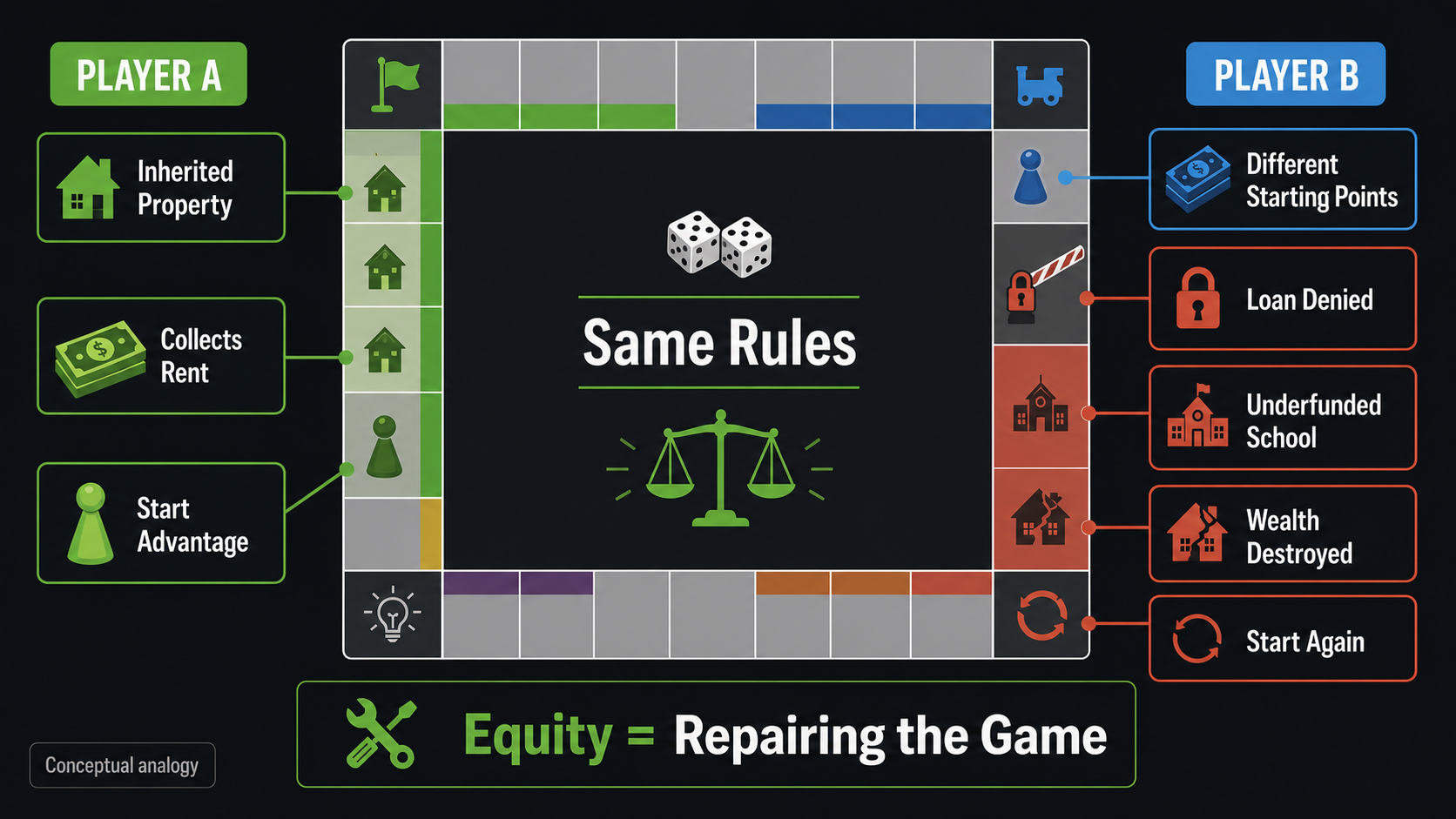
That is systemic racism.
Equal rules can still produce unequal results when the game has been unequal for generations.
The honest answer is: they did
And sometimes people ask, “Well, why didn’t Black people just build their own communities and create their own wealth?”
The honest answer is: they did.
Greenwood in Tulsa, Oklahoma, known as Black Wall Street, was a thriving Black community with businesses, homes, churches, doctors, lawyers, and schools. In 1921, it was violently destroyed. Rosewood, Florida, was attacked and burned in 1923. Wilmington, North Carolina had Black political leadership, businesses, and newspapers before a white supremacist coup in 1898 overthrew the local government. In Forsyth County, Georgia, racial violence in 1912 helped force Black residents out of communities including the Oscarville area; decades later, parts of that land were submerged under Lake Lanier.4
Wilmington, North Carolina: A white supremacist coup overthrew local government and attacked Black civic life.4
Forsyth County, Georgia: Racial violence helped force Black residents out of the county, including the Oscarville area.7
Greenwood, Tulsa: The district known as Black Wall Street was devastated by mob violence.2
Rosewood, Florida: A Black community was destroyed after days of racial terror.5
So in the Monopoly example, it’s not just that some players started with less. It’s that when they did buy property, build neighborhoods, and create wealth, mobs or systems sometimes came through, flipped the board over, took the pieces, and told them to start again.
That kind of history doesn’t disappear just because the laws change. If a family lost a home, business, land, or safety decades ago, they didn’t only lose what existed then. They lost the equity, stability, and opportunity that could have grown from it.
Acknowledging history does not erase anyone else’s struggle
That doesn’t mean every white person has had an easy life. Many have struggled deeply. But systemic racism means race has been one added barrier for some people, built into the structure of the game.
When people ask for equity, they are not asking for special treatment. They are asking us to notice that the game has not been fair for a very long time. If we truly believe in fairness, we have to care about today’s rules and yesterday’s starting points.
To me, understanding systemic racism starts with humility. It means listening without getting defensive. Acknowledging someone else’s disadvantage doesn’t erase your own struggles. It simply makes room for a fuller truth.
And once we can see the board clearly, maybe we can finally start making the game fair for everyone.
- Lamont Tyson, “Mom Uses MONOPOLY to Explain Systemic Racism,” YouTube Shorts, youtube.com; Lamont Tyson channel, youtube.com/@LamontTyson
- National Archives, “Remembering the Tulsa Race Massacre,” May 2021, archives.gov
- Tulsa Historical Society & Museum, “1921 Tulsa Race Massacre Kiosk Exhibit,” tulsahistory.org
- North Carolina Department of Natural and Cultural Resources, “1898 Wilmington Coup,” dncr.nc.gov
- Florida Department of State, Division of Library and Information Services, “Rosewood,” dos.fl.gov
- NCpedia, “The Wilmington Coup - 1898,” revised Aug 2022, ncpedia.org
- LakeLanier.com, “Lake Lanier History,” lakelanier.com
- Lost Black Land of Forsyth County, “The Myth of Oscarville: Setting the Record Straight,” Jun 2025, lostblacklandforsyth.org